

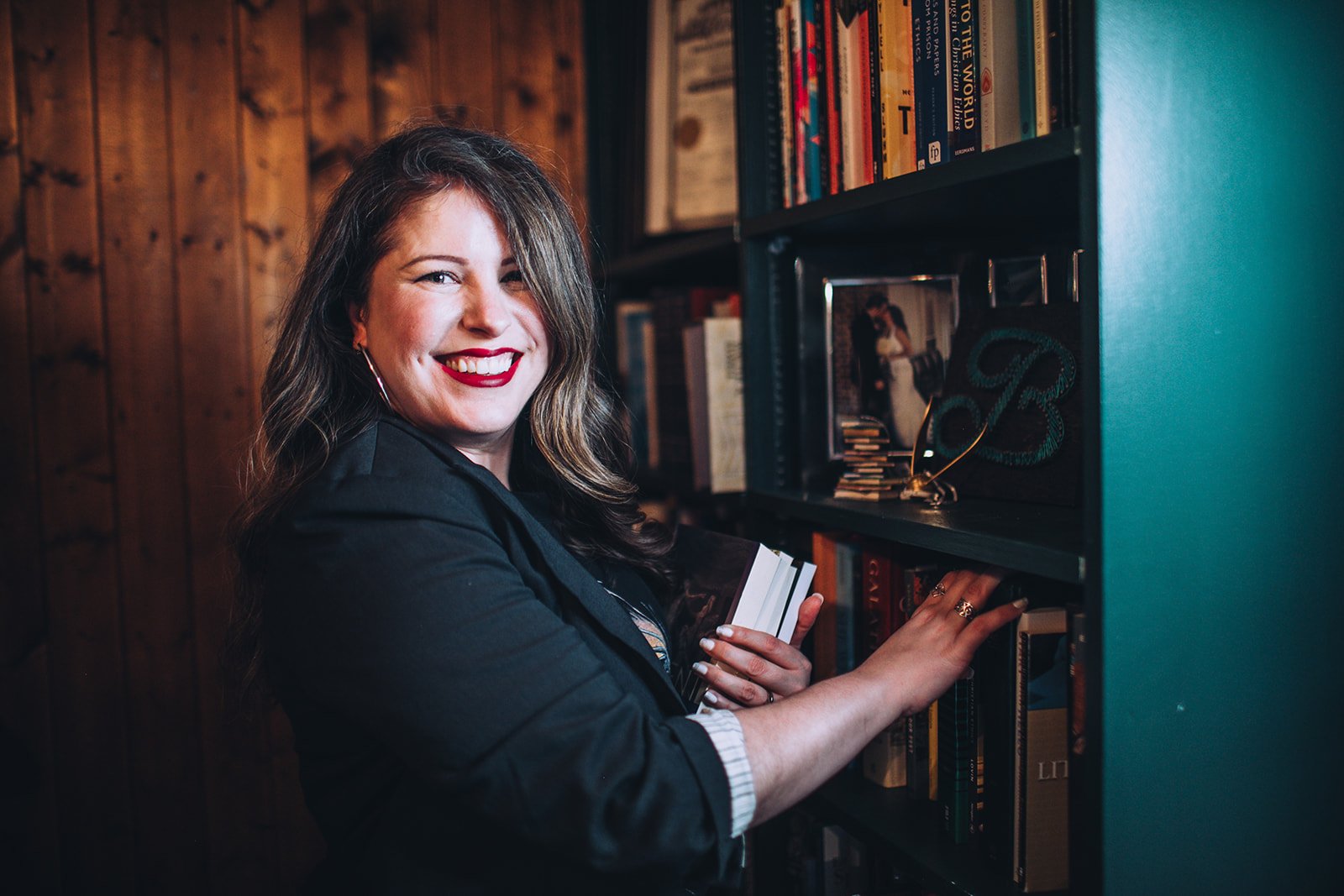
Your Back Pocket Bible Scholar for Recovering Evangelicals
Read the Bible to behold God and to become like Jesus,
not learn to behave so you can belong
You left the church that taught you how to read the Bible.
You don't have to leave the Bible too.
I'm Kate Boyd. I have a master's in biblical studies from Perkins School of Theology, I read Hebrew and Greek, and I write books that help us come back to Scripture and find there's good news there, for us and for everyone else.
So you can read Scripture without going back to the interpretations that hurt you.
Five weaponized passages, handled with care. Free, and it starts the day you sign up.
Read it literarily, not literally.
The Bible isn't one book. It's a library, written across centuries in three languages by people who had genres and conventions and arguments with each other.
Poetry doesn't work like law. Apocalypse doesn't work like history. Reading literarily means asking what kind of thing you're holding before you ask what it means for Tuesday. Most of what got you hurt came from skipping that question.
My method: four threads, pulled apart and woven back together.
Literary: genre, structure, characters, and what the rest of Scripture is doing with this text
Language: a word or two in Hebrew or Greek, and what the grammar is doing
Lifetime: the historical and cultural world the text came out of
Lenses: what scholars from different places and backgrounds see in it, including where they disagree

What you can't Google
Almost everything free on a hard passage skews evangelical or a little to the right of that, and the work that would change your reading sits in journal articles and academic commentaries that cost more than most people will pay to settle a question.
And that’s the part I’m here for. When a passage is contested and the stakes are personal, I help you see there’s more than one way to read it faithfully.

I’m Kate.
I couldn't open Revelation until I was almost thirty. I was too scared of it. I'd been handed a Bible and a set of rules for reading it, and the rules kept producing a God I didn't recognize and answers that hurt people I loved.
So I went and got trained. I earned an MTS in biblical studies at Perkins School of Theology and wrote An Untidy Faith while I was there. My book on King David is coming from Brazos Press in fall 2027.
What I found in the academy was a wider room, not a demolition.
Scholars have been sitting with these questions for decades, and most of that work never reaches the people who need it most. It's locked in journals and written for other scholars. My whole job is carrying it across.
I have an academic library card. Consider it yours.

This is for you If …
You still love Jesus, and you can't unsee what you've seen
You want to take the Bible seriously, which is exactly why the flat literal reading stopped working
You want to know who the scholars are and what they argue, not just be told what to think
You've been burned by certainty, and you're not looking for a new brand of it
This probably isn’t for you if …
You want someone to hand you the correct interpretation and a five-step application. I'll show you the disagreement and the evidence and let you sit with it. Some people find that freeing. Some find it exhausting. Both are fair.
Revisit Bible passages that have been used against you
Reconstruct with joy even in the messy middle of your faith
Start Here
Read about the cultural forces that shape the American church
Give every passage a whole moon
Re-Verse: Five passages to revisit after evangelicalism
When you sign up for my newsletter, The Wide Margin, you'll get these five lessons free by email. Each one takes a passage that got used as a weapon and runs it through the four threads.
Each one takes a passage that got used as a weapon and runs it through my four threads for understanding Scripture.
1 Thessalonians 4: the rapture, and why the people who wrote it weren't picturing what you were shown
Jeremiah 29:11: the verse on the coffee mug, and who God was talking to
Proverbs 31: a poem about a woman, not a job description for one
1 Timothy 2:9–10: modesty, and what it cost you
1 Corinthians 6:9 and 1 Timothy 1:10: where the scholarship divides, and why the words we choose and the questions we ask matter
Follow me on Social · Follow me On Social · Follow me on Social ·
Follow me on Social · Follow me On Social · Follow me on Social ·
Give every passage a whole moon

When you're ready to go deeper and start repairing your relationship with Scripture, the paid tier of The Wide Margin includes Moon & Marginalia: a monthly deep Bible study, paced by the moon.
What we lost when we left was the rhythm, not the need for one. The moon cycle is a rhythm nobody had to invent. It doesn't require a building, and it shows up on schedule whether or not we were paying attention.
We use the rhythm of God's natural revelation to help us be formed by God's special revelation in Scripture. One book of the Bible at a time, one passage per lunar month, in four written lessons: Encounter, Widen, Deepen, Embody.
We work through one book at a time. You get the full method, the citations, and a place to ask me the question that didn't make it into the lesson.
$5 a month, or $50 a year.
The first cycle, four lessons on Isaiah 40, is permanently free.
Read all of it before you decide. That's the closest thing to a guarantee I can offer, and it's better than a refund policy because you never have to ask for your money back.